
The Documents Every Adult Should Have

How many important documents could someone find if they suddenly needed to help manage your affairs?
Your Will. Your Enduring Powers of Attorney. Your insurance policies. Your bank accounts. Your mortgage. Your investments. Your business records. Your important contacts. You might know exactly where everything is.
But would someone else?
It's something most of us don't think about until we're forced to.
And while nobody likes imagining a situation where someone else needs to step in and help manage their affairs, having important information organised can make things considerably easier when life doesn't go according to plan.
Start with the basics: your Will
A Will is one of the most important documents to consider as part of your estate planning.
It can set out your wishes for how your estate is intended to be dealt with after your death, subject to the relevant legal arrangements.
It can also include important appointments and directions depending on your circumstances.
Your Will should reflect your current situation and wishes.
That means it's worth reviewing it when your circumstances change.
Buying a home.
Having children.
Getting married or separating.
Starting or selling a business.
Significant changes to your assets.
A Will created years ago may no longer reflect the life you've built today.
Your solicitor can provide advice about what should be included in your Will and when it should be updated.
What about if you're still alive?
A Will deals with what happens after you die.
But what happens if you're still alive and unable to make decisions for yourself?
This is where an Enduring Power of Attorney (EPOA) can be important.
An EPOA allows you to appoint someone to act on your behalf in specified circumstances, subject to the legal requirements and the type of EPOA involved.
It can cover areas such as property and financial matters, and personal care and welfare.
An EPOA needs to be arranged while you have the legal capacity to make that decision, so it's not something you necessarily want to leave until someone is already unable to make their own decisions.
A solicitor can explain the different types of EPOA and help you understand what may be appropriate for your circumstances.
Don't forget your insurance
If someone needed to help manage your affairs, would they know what insurance you have?
You may have Life Insurance, Trauma Cover, Income Protection, Medical Cover or other forms of personal insurance.
If you're a business owner, you may also have Key Person Cover, Shareholder Protection, Debt Protection or other business insurance arrangements.
You don't necessarily need to have all of these.
The important question is:
Would the right people know that they exist?
And would they know who to contact?
Keeping a record of your insurer, policy details, policy ownership and adviser can make it easier for someone to understand what protection is in place when they need to.
Your financial records matter too
Your financial life can involve far more than a bank account.
Think about what someone might need to know if they had to help manage your affairs.
Do you have:
Bank accounts?
A mortgage?
Personal loans?
Credit cards?
Investments?
KiwiSaver?
Shares?
Property?
Trust interests?
Business interests?
Guarantees or other financial commitments?
You don't necessarily need to give someone access to all of these accounts.
But having a clear record of what exists — and where the relevant documents can be found — can save a great deal of time and confusion.
Who would they need to contact?
This is one area that can be surprisingly difficult to work out. You might know your solicitor's name. Your accountant's number might be saved in your phone. Your financial adviser might have all your insurance records.
But if you couldn't explain any of that yourself, would your family know where to start?
There may be several people who could be important in an emergency or following your death.
Your solicitor. Your accountant. Your financial adviser. Your insurance adviser. Your EPOA. Your executor or trustee. Perhaps a family member, close friend, pastor, priest or celebrant.
The New Vision Emergency Locator specifically provides space to record these key professional and personal contacts, so the people stepping in know who may need to be contacted.
What about the people around you?
Your immediate family may not be the only people who need to know.
There may be relatives who should be notified.
Friends who are important to you.
People connected to your work or business.
People who may have an important role in supporting your family.
The Emergency Locator includes sections for relatives to notify and other people to contact, recognising that the practical process of dealing with an emergency or someone's death can involve much more than simply contacting the immediate family.
There are things you may want to say yourself
Estate planning isn't only about financial documents.
There may be personal wishes that you would like your family to know.
The Emergency Locator includes a section where you can record your own funeral wishes, including thoughts around a eulogy, music, flowers, hymns, songs or prayers, who you would like to speak and other preferences.
These aren't necessarily things that belong in a Will.
But they may be things your family would appreciate knowing.
After all, when someone dies, their family isn't only dealing with financial and legal decisions.
They're also trying to say goodbye.
Having your wishes written down can help remove some of the guesswork at an incredibly difficult time.
Where are your documents?
Here's a simple question that can reveal a surprisingly large gap:
If someone had to step into your shoes tomorrow, could they find everything?
You might have your Will at your solicitor's office.
Your insurance documents could be in an email inbox.
Your mortgage documents might be in a filing cabinet.
Your investment information could be online.
Your business documents might be at work.
Your EPOA could be somewhere else entirely.
You know where to find them because you've accumulated them over time.
Someone else may have no idea.
The Emergency Locator includes a dedicated Document Location section where you can record where important documents are kept, including your Will, EPOAs, life policies, property documents, mortgages and loans, bank and credit card information and other important records.
It also provides space to record where documents are stored - for example, at home, at the office, in a safe deposit location or somewhere else.
That may sound like a small detail.
But when someone needs information quickly, knowing where to look can make a significant difference.
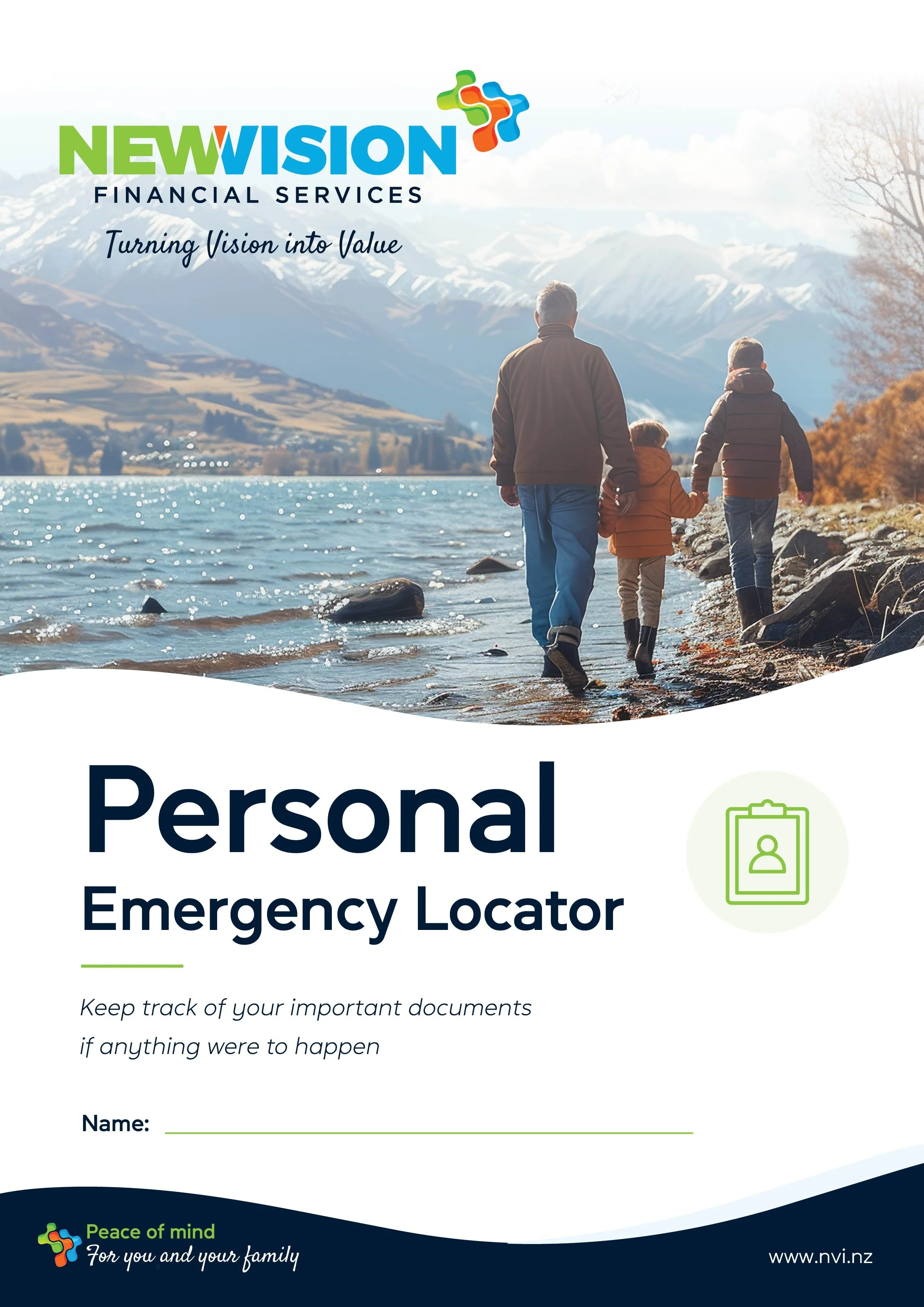
Introducing the New Vision Emergency Locator
This is why we created the New Vision Personal Emergency Locator.
It is designed to help you bring together the important information someone may need if you are involved in an emergency or if they need to deal with your affairs.
It includes sections for:
Personal information — including your details, partner's details and children's details.
Relatives and people to notify — so important people aren't forgotten.
Professional advisers — including your solicitor, accountant, financial adviser and insurance advisers.
Key people — such as your EPOA, executor or trustee and other important contacts.
Important documents — including your Will, EPOAs, insurance policies, property documents and financial records.
Document locations — so someone knows where those documents can actually be found.
Personal wishes — including information you may want your family to know about your funeral and other arrangements.
The Emergency Locator also recommends keeping it up to date and reviewing it at least annually, or whenever your details, documents or key contacts change.
Keep it somewhere safe - and make sure someone knows where it is
Having an Emergency Locator is only useful if the right person can find it.
The document suggests leaving it with someone you trust or storing it somewhere secure that important people know about. It could also be stored digitally, provided the appropriate people know where it is and can access it when needed.
The objective isn't to give everyone access to your private financial information.
It's to make sure that the people who may legitimately need to help you aren't left wondering where to start.
You don't have to organise everything today
Estate planning can feel like a big job.
There are legal documents to consider.
Financial information to gather.
Insurance policies to locate.
Important contacts to identify.
You don't need to do everything at once.
Start with the basics.
Do you have a current Will?
Do you have appropriate EPOAs in place?
Do you know what insurance you have?
Do you know where your important financial documents are?
Would someone else know who to contact?
Would they know where to find everything?
Those questions alone may identify something worth organising.
Making life easier for the people around you
None of us knows exactly what the future holds.
But we can make some things easier for the people around us.
We can put our legal arrangements in place.
We can keep our financial information organised.
We can make sure our insurance details can be found.
We can tell the right people where important documents are.
And we can record the wishes that matter to us.
It isn't about expecting something bad to happen.
It's about recognising that if someone has to step into your shoes, they shouldn't also have to become a detective.
You've spent years building your life.
Taking the time to organise the important information can help the people around you know what to do when they need it most.
Your New Vision Emergency Locator
If you don't already have a system for keeping your important information together, the New Vision Personal Emergency Locator can provide a practical starting point.
It is designed to help you record the people, documents, advisers, financial information and personal wishes that may be important in an emergency or when your family needs to deal with your affairs.
Speak to the New Vision team if you would like to chat more about our Personal Emergency Locator.
Glen Hatcher
Financial Adviser
New Vision Financial Services
Plan your future and let us help you have peace of mind along the way.